
Different Types of Metal Spinning
Explore the various types of metal spinning and their applications in modern manufacturing. Metal spinning — also called spin forming or metal turning — is a chipless metal forming process that turns a flat metal blank into a seamless, axially symmetrical part. This guide breaks the process down two ways: by machine, covering manual, power-assisted and automatic spinning lathes, and by operation, covering conventional spinning, shear spinning, preforms and edge treatment. Together they explain how manufacturers match a metal spun component to its material, geometry, precision requirement and production volume.
What Is Metal Spinning?
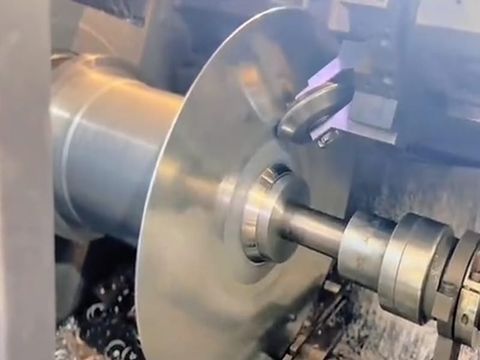
Metal spinning, also known as spin forming, metal spun forming, metal turning or metal forming, is a cold, chipless process in which a flat circular blank is clamped against a rotating mandrel and spun at high speed while a roller or forming tool presses the metal progressively onto the mandrel contour. The tool never cuts material away — it displaces metal in a continuous, localized plastic deformation, so the blank becomes a hollow, seamless, rotationally symmetrical part such as a bowl, cone, cylinder, hemisphere, dome, dished end or housing.
The underlying principle is always the same: the mandrel defines the inside geometry, the roller defines the outside geometry, and the gap between them controls the final wall thickness. Because deformation is concentrated in a small contact zone at any instant, metal spinning requires far lower forming forces than pressing or deep drawing of the same part, which is why relatively light, non-dedicated tooling can produce components several metres across.
The craft itself is centuries old — early examples have been traced to hand-operated lathes in an Egyptian Pharaoh's tomb — but modern CNC metal spinning has turned it into a repeatable, data-driven manufacturing process capable of holding tolerances of ±0.1 mm on large, heavy-gauge parts. Metal spinning can be performed on several types of lathe and through several forming operations, and choosing the right combination is what delivers precision and efficiency.
Metal Spinning Lathes
Metal spinning lathes are generally classified into three categories: manual, power-assisted, and automatic. The classification describes how the forming force is generated and controlled, and it is the single biggest factor in the precision, repeatability and throughput a shop can offer.
Manual Spinning Lathes
Manual spinning lathes handle flat blanks from 1.0″ to 72″ (roughly 25 mm to 1,830 mm) in diameter. A skilled operator shapes the metal using a forming tool — a hand-guided roller, spoon or lever — while controlling both the spindle speed and the forming force by feel. The operator senses the metal's grain, hardness and willingness to move in a given direction, and works the material with precise, incremental motions rather than brute force.
This makes manual spinning suitable for a wide range of blank sizes and for intricate, low-volume work: prototypes, one-off components, decorative and architectural pieces, large parabolic forms and short production runs. Tooling is inexpensive — wooden or soft-steel mandrels are common — and setup is fast, so manual spinning is often more economical than programming a CNC machine for a very short run. Its limitation is efficiency and consistency: output depends on operator skill, and part-to-part repeatability cannot match an automated machine.
Power-Assisted Spinning
Power-assisted spinning combines manual spinning with hydraulic cylinders. The operator still guides the forming tool and controls the sequence, but the machine supplies much of the forming force hydraulically, which makes it possible to shape stronger metals — stainless steel, high-strength alloys and heavier gauges — that a purely manual lathe cannot handle. It is ideal for larger, thicker parts where forming loads are high but full CNC programming is not justified.
In practice, power-assisted machines occupy the middle ground: more capable and more consistent than hand spinning, yet cheaper and more flexible than a fully automatic cell. They are widely used where a shop needs to form tough materials in small to medium batches, or to rough out a part before finishing.
Automatic Spinning
Automatic spinning uses CNC-controlled lathes that automate the process, improving precision, consistency and production efficiency. A machinist programs the roller path, feed rate, spindle speed and forming sequence; the machine then repeats it exactly, applying predetermined hydraulic forces for predetermined times at precise points on the blank.
The benefits of automatic CNC spinning include:
- High repeatability — every part experiences identical forming conditions, eliminating operator-to-operator variation
- Tight tolerances — advanced machines hold ±0.1 mm on diameter and height, with excellent wall-thickness control
- Fast cycle times — programs can be stored, transferred between machines and refined for future runs
- Full automation — modern cells can load blanks, form the part, trim or finish the edges and eject the finished component
- CAD/CAM integration — tool contours can be imported and validated by simulation before cutting metal
Automatic spinning is the right choice for high-volume or high-precision parts, and it is the reason CNC metal spinning now dominates industrial production. It is less economic for a single prototype, where programming and setup time can outweigh the savings.
Metal Spinning Operations
Four main operations define metal spinning: conventional, shear, preforms, and edge treatment. Each operation produces a different result on wall thickness and part geometry, so the choice follows the drawing rather than the machine.
Conventional Spinning
In conventional spinning, metal is shaped by a roller over a rotating blank in multiple passes, forming symmetrical shapes such as bowls, cups, domes and dished ends. The blank is lubricated, clamped between the mandrel and the tailstock, and rotated at a speed matched to the material, diameter and thickness. The roller then follows a programmed path — usually from the centre outward or from the rim inward — making a series of forward, backward and planishing passes, each pushing the metal a little closer to the mandrel.
The signature of conventional spinning is that wall thickness stays close to the original blank thickness; the metal is redistributed rather than deliberately thinned. That makes it highly versatile and cost-effective: it suits shallow axisymmetric parts, requires only light tooling, and gives excellent surface finish once the final planishing passes smooth out waviness, springback and residual stress.
Shear Spinning
Shear spinning, also called shear forming, produces precise conical or cylindrical shapes in a single pass without excessive thinning. Unlike conventional spinning, the wall thickness is intentionally reduced while the original blank diameter is maintained, and the geometry follows the sine law: final wall thickness equals the initial blank thickness multiplied by the sine of the cone's half-angle. Shear angles typically range from 12° to 18°, so purely cylindrical shapes cannot be produced by shear forming alone.
Because the metal is stretched onto the mandrel in one controlled pass under high axial force, shear spinning is highly accurate and efficient, and the intense work hardening leaves the part stronger and more fatigue-resistant than the blank. It is the preferred route for thin-walled cones, nose cones, rocket casings and pressure-vessel domes. Where the requirement is a long, thin-walled hollow cylinder rather than a cone, the same family of technology is extended by flow forming (tube spinning), which reduces wall thickness by 50–80% while elongating a tubular blank.
Preforms
Preforms are pre-shaped blanks of sheet metal, brass, aluminium or copper that are used as the starting point for spinning rather than a flat disc. Feeding a preform into the process optimizes material use and improves repeatability: the blank is closer to the finished geometry, so less material is displaced, fewer passes are needed, and the resulting wall-thickness distribution is more consistent from part to part.
Preforms are particularly valuable in three situations — deep draws where a flat disc would thin or wrinkle excessively, parts with a thickened base or boss that must be preserved, and production runs where blank cost and scrap are significant. In effect, a preform moves part of the forming work upstream, trading a slightly more complex blank for a shorter, more stable spin cycle.
Edge Treatment
Edge treatment covers the trimming and finishing of the rim of a spun part. Metal spinning typically leaves sharp, ragged or uneven edges, so the part is trimmed to final height and diameter with a sharp trimming tool to remove burrs, create a clean, even edge and ensure compliance with specifications.
Trimming is only the first step. Depending on the application, the edge is then beaded for strength, curled or hemmed for safety, or flanged so the component can mate with another part. A smooth, rounded, dimensionally consistent rim improves both the safety and the performance of the metal spun part, and it is often followed by polishing, passivation or coating as part of the same order.
Choosing the Right Type of Metal Spinning
This variety of spinning methods allows manufacturers to select the most suitable process depending on material, shape, precision requirements, and production volume. As a rule of thumb:
- Prototypes, one-offs and intricate shapes → manual or power-assisted spinning
- High-volume, high-precision parts → automatic CNC spinning
- Constant wall thickness, shallow axisymmetric forms → conventional spinning
- Thin-walled cones and tapered components → shear spinning
- Long, thin-walled cylinders → flow forming (tube spinning)
- Deep draws, thickened bases and material-critical parts → preforms
- Any finished part → trimming plus the appropriate edge treatment
The most cost-effective route is rarely the most obvious one. Reviewing the drawing, the material, the tolerance stack-up and the annual volume together usually reveals whether the part should be hand spun, power-assisted or programmed on a CNC lathe — and which forming operation will hit the performance target at the lowest total cost.
Conclusion
From manual lathes sized for a 1-inch blank to automatic CNC machines forming parts more than two metres across, metal spinning spans a remarkable range of capability. The three lathe types — manual, power-assisted and automatic — set the level of precision and efficiency, while the four operations — conventional spinning, shear spinning, preforms and edge treatment — define the geometry and wall-thickness outcome. Used together, they let manufacturers produce strong, lightweight, seamless metal spun components from aluminium, stainless steel, carbon steel, copper, brass, titanium, Inconel and Hastelloy, at tolerances that competing metal forming processes cannot match economically.


