
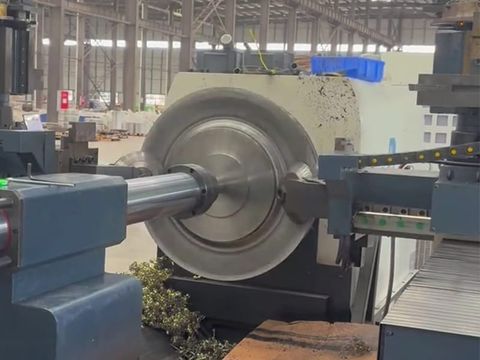
Conventional Metal Spinning
Conventional spinning is a core metal spinning process used to produce precise, axisymmetric components with near-constant wall thickness. In conventional spinning, a rotating sheet metal blank is formed over a rotating mandrel by a roller tool that applies localized pressure; the roller follows a predetermined path with multiple passes, incrementally shaping the metal until the interior surface matches the mandrel contour. Because metal is displaced rather than cut away, conventional spinning delivers metal spun parts with high material utilization, low forming loads, non-dedicated tooling and consistently strong mechanical properties — making it one of the most versatile and cost-effective methods in modern metal forming.
What Is Conventional Metal Spinning?
Conventional metal spinning is a cold metal forming process in which a flat metal disc — the blank — is clamped against a rotating mandrel and rotated at controlled speed while a roller or spinning tool presses the material progressively toward the mandrel contour. The roller never removes material; instead it displaces metal in a continuous, localized plastic deformation, so the blank is reshaped into a hollow, rotationally symmetric part rather than cut into shape.
The process is known by many names across the industry. Engineers refer to it as metal spinning, metal spun forming, spin forming, metal turning, metal forming, CNC metal spinning, or simply spinning. Whatever the label, the underlying principle is the same: a rotating mandrel defines the inside geometry, a roller defines the outside geometry, and the gap between them controls the final wall thickness.
Conventional spinning has been practiced for centuries — early examples have been traced to an Egyptian Pharaoh's tomb, where craftsmen shaped metal on hand-operated lathes. The Industrial Revolution motorized the lathe, and modern CNC spinning machines have since turned the craft into a repeatable, data-driven manufacturing process capable of holding tolerances of ±0.1 mm on large, heavy-gauge components.
How the Conventional Spinning Process Works
A conventional spinning cycle follows a well-defined sequence:
- Blank preparation. A flat, circular blank is cut from sheet or plate and its edges are deburred. The blank is lubricated with wax, grease or a dedicated forming lubricant to reduce friction and improve surface finish.
- Clamping and rotation. The blank is centered on the mandrel and clamped by the tailstock. The spindle then rotates the mandrel and blank together at a speed determined by material, diameter and thickness.
- Incremental forming. A roller applies localized pressure at a single point of contact and travels along a programmed path — typically from the center of the blank outward, or from the rim inward, depending on the part and tooling strategy.
- Multiple passes. The roller does not reach the final form in one move. Instead it makes a series of passes, each pushing the metal a little closer to the mandrel. Coordinated control of roller position, feed rate and spindle speed keeps the deformation stable.
- Finishing and planishing. Final passes — called planishing — smooth the surface, remove waviness and tighten dimensional accuracy.
- Secondary operations. Trimming, beading and hemming, CNC machining, welding, polishing, pickling and passivation, anodising or powder coating complete the metal spun part.
Because deformation is concentrated in a small contact zone at any instant, conventional spinning requires far lower forming forces than pressing or deep drawing of the same part. That is why relatively light, non-dedicated tooling can produce large components.
Multipass Control: Forward, Backward and Planishing Passes
In multipass conventional spinning, the number and direction of roller passes are the primary levers for controlling final wall thickness and part quality.
Forward passes advance the roller in the direction of material flow and slightly thin the wall. A controlled, incremental reduction per pass keeps strain distributed instead of concentrated.
Backward passes work in the opposite direction and redistribute metal back along the wall. They help even out thickness variations created by earlier forward passes, reduce springback, and relieve the residual stresses that cause a spun part to open up or distort after release.
Planishing (intermediate and finishing) passes apply light, high-contact pressure with a smooth roller or tool to flatten surface waviness, refine the surface finish and lock in dimensional accuracy.
The practical result is a wall whose thickness stays close to the original blank thickness across the part — the defining characteristic of conventional spinning — while the geometry follows the mandrel precisely.
The Forming Action Behind Conventional Spinning
Conventional spinning imparts continuous, localized plastic deformation to the workpiece. Each element of material is deformed many times in small increments as the roller sweeps past it, which produces several important effects:
- Flexible processing. The same machine and basic tooling can produce many different part geometries by changing the roller path program.
- Low forming loads. Only a small volume of metal is deformed at any moment, so machine tonnage requirements are modest compared with stamping or deep drawing.
- Non-dedicated tooling. A single mandrel can serve a wide family of similar parts, and design changes usually mean a program edit rather than a new die.
- High material utilization. Almost the entire blank becomes part of the finished component; scrap is limited largely to trimming allowance.
- Low production costs. Reduced tooling investment, short setup times and minimal scrap make conventional spinning economical for prototyping, small batches and medium-volume production alike.
- Improved mechanical properties. Because the metal is cold-worked as it flows over the mandrel, the finished metal spun part is typically stronger and harder than the original blank, with a continuous, seam-free grain structure.
The finished part has no seams or joints, which reduces the risk of failure under pressure, fatigue or high stress — a decisive advantage for pressure vessels, tank heads and rotating components.
Process Classification: Where Conventional Spinning Fits
Metal spinning is an umbrella term that covers three principal variants, distinguished primarily by the wall thickness of the part after forming:
- Conventional spinning. The wall thickness stays close to the original blank thickness. The blank is progressively shaped over the mandrel with little intentional thinning.
- Shear spinning. The wall is deliberately thinned according to a sine law relationship between the blank diameter, the final diameter and the blank thickness, producing a wall much thinner than the starting material.
- Flow forming. Material is displaced axially over a mandrel by rollers to create long, thin-walled, high-precision cylinders and tubes, often with wall reductions far beyond shear spinning.
Conventional spinning is governed by tensile–compressive stresses and therefore belongs to the same family of deformation mechanics as bending and deep drawing. Additional classifications used in industry further describe how the process is executed:
- Mandrel spinning versus mandrel-free spinning — whether a solid form tool supports the inside of the part.
- Internal versus external spinning — whether the mandrel controls the inside or the outside surface.
- Single-roller versus opposing-roller configurations — opposing rollers balance radial forces and improve thickness control on heavy parts.
- Cold spinning versus hot spinning — hot spinning applies localized heating to lower flow stress for thick, low-ductility or high-strength alloys.
- Manual spinning versus CNC spinning — hand-controlled lathes for simple, low-volume work; CNC spinning machines for repeatability, complex profiles and tight tolerances.
Shapes Produced by Conventional Spinning
Spun parts can take a wide range of rotationally symmetric forms, including:
- Conical and trumpeted shapes
- Dished ends and tank heads
- Domed and hemispherical (half-sphere) forms
- Cylindrical and lid-shaped parts
- Flanged, flanged-and-flued, and flanged-dished-and-flued profiles
- Parabolic (bell-shaped) and semi-elliptical profiles
- Toroidal (donut-shaped) parts
- Venturi (hourglass) and reducing/expanding transitions
- Complex combinations and stepped multi-diameter bodies
In all cases, the finished diameter is smaller than the original blank diameter, while the wall thickness remains substantially consistent — the signature of conventional spinning.
Materials for Conventional Metal Spinning
Conventional spinning can form metals that other processes struggle with, including many high-strength and heat-resistant alloys. Commonly spun materials include aluminium and aluminium alloys, stainless steel, carbon steel and Corten steel, copper, brass, bronze, titanium, silver, Hastelloy and Inconel alloys, and Mu-metal.
Metals with lower ductility or higher strength typically require inter-pass annealing or hot spinning to keep the material flowing without cracking. Aluminium alloys such as 5A02-H112 and 5052, high-strength grades such as 6061-T6, high-temperature stainless steels such as SUS310S, and high-strength structural steels such as Q355 are all routinely spun in production environments.
Advantages of Conventional Metal Spinning
Compared with alternative metal forming methods such as stamping, deep drawing, hydroforming, casting or machining, conventional spinning offers a distinctive combination of benefits:
- Near-constant wall thickness with a smooth, seamless, symmetrical result.
- Low tooling cost — a mandrel rather than a matched die set.
- Fast setup and short lead times, typically measured in days for small to medium batches.
- Design flexibility — geometry changes are usually a programming change, ideal for prototyping and iterative development.
- Excellent material utilization and less waste, supporting more sustainable production.
- Work-hardened, stronger parts with a continuous grain structure and no weld seams.
- Scalable volumes — the same process serves one-off bespoke components and repeat production runs.
- Tight tolerances — modern CNC spinning routinely holds ±0.1 mm on critical features, with in-house polishing, electropolishing, pickling, passivation and anodising to finish the part.
Conventional Spinning Versus Other Metal Forming Methods
Understanding the boundaries of the process helps engineers choose correctly:
- Versus deep drawing and stamping: those processes push a blank into a negative cavity with matched dies and high tonnage; conventional spinning forms around a positive mandrel with a single roller and much lighter tooling, which suits lower volumes and larger diameters.
- Versus shear spinning: shear spinning intentionally thins the wall to a sine-law target; conventional spinning preserves near-original thickness.
- Versus flow forming: flow forming produces long, thin-walled precision cylinders by axial material displacement; conventional spinning shapes the blank into a hollow form at close to blank thickness.
- Versus machining: machining removes metal to create a shape, whereas spinning displaces it — spinning wastes far less material and preserves a continuous grain flow, though it is limited to rotationally symmetric geometry.
- Versus casting: spinning avoids porosity and delivers higher, more predictable mechanical properties.
Conventional spinning is not the answer when severe non-axisymmetric bending or complex internal features are required; those cases call for machining or other forming routes.
Common Challenges and How They Are Controlled
Three failure modes dominate conventional spinning, and each is managed through process design:
- Wrinkling. Compressive circumferential stress can buckle the unsupported wall. Controlled roller feed rates, an appropriate number of passes, edge support and correct spindle speed prevent it.
- Excessive thinning and cracking. Over-aggressive forward passes can localize strain. Incremental reductions per pass, inter-pass annealing and lubrication keep strain within the material's forming limits.
- Springback and distortion after release. Residual stresses cause the part to move when it leaves the mandrel. Backward passes, planishing passes and stress-relief heat treatment stabilize the final geometry.
Robust process control — roller path programming, real-time monitoring, dimensional inspection with 3D scanning or laser metrology, and statistical process control — converts these variables into predictable, repeatable output.
Equipment and Tooling
A conventional spinning setup consists of a spinning lathe or CNC spinning machine with a headstock, tailstock, spindle and lathe bed, plus the tooling that defines the part:
- Mandrel (form tool) — supports the workpiece and defines the internal contour of the finished part.
- Rollers and spinning tools — apply the localized lateral force that deforms the metal; roller profile, radius and material compatibility strongly influence surface finish and thickness control.
- Follower and pressure pad — clamp and stabilize the blank, especially during the early passes.
- Measurement and finishing equipment — CMMs, 3D scanners, laser trackers, polishing and surface-treatment lines.
Modelling the process in CAD/CAM before cutting metal allows the roller path and pass schedule to be simulated, shortening development and reducing trial cost.
Applications and Industries
Metal spun components reach into nearly every sector of manufacturing, including aerospace and defence, automotive and commercial vehicles, energy and power generation, chemical and petrochemical processing, food processing and food service, HVAC and air filtration, medical equipment, commercial lighting and architectural metalwork, marine, rail, agriculture, waste management, pollution control, electrical equipment and consumer cookware.
Typical conventional spun parts include tank heads and dished ends, pressure vessel components, gas cylinders, nozzles and venturi sections, engine and turbine housings, air filter housings, wheel rims and hubcaps, mixer bowls, funnels, reflectors and light housings, decorative architectural elements and musical instrument bells.
Why Conventional Spinning Remains a Core Metal Forming Process
Conventional spinning occupies a unique position in metal forming. It pairs the material efficiency and mechanical performance of cold working with tooling economics closer to fabrication than to die-based production. For rotationally symmetric parts — from a prototype dished end to a production run of stainless steel tank heads — it consistently delivers near-constant wall thickness, seamless geometry and reliable mechanical properties at competitive cost.


