
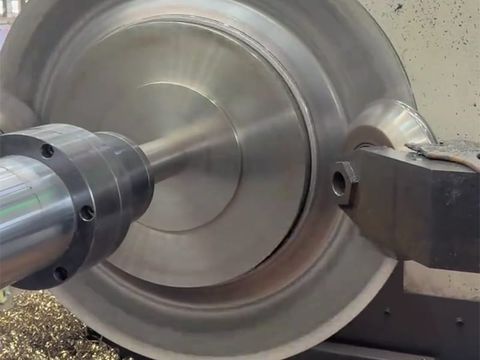
Modernization of Metal Spinning
The modernization of metal spinning is driven primarily by the adoption of Computer Numerical Control (CNC) technology, which replaces traditional hand spinning with automated, programmable forming processes. CNC metal spinning follows precise CAD-based tool paths to control forming rollers and tooling, ensuring repeatable and highly accurate results across production runs. Unlike manual spinning, CNC metal spinning minimizes operator dependency and enables continuous, high-volume manufacturing with tight tolerances and consistent quality. By combining automation, precision, and cost control, it has become a strategic manufacturing solution for producing axisymmetric metal components with excellent structural integrity and surface quality.
CNC Automation in Metal Spinning
Metal spinning — also known as metal spun forming, spin forming, or spin forming metal fabrication — has long been one of the most efficient ways to shape axially symmetric metal parts. A flat metal disc or tube is rotated at high speed on a lathe and pressed against a mandrel by a roller, gradually taking the shape of the tool. For decades, this was a hand-spinning craft: a skilled operator controlled the roller by feel, and the quality of the finished part depended almost entirely on the operator's experience.
The modernization of metal spinning is driven primarily by the adoption of CNC (Computer Numerical Control) technology. Instead of relying on manual force and intuition, a CNC spinning lathe executes a pre-programmed sequence of roller movements, feed rates, spindle speeds, and multi-pass forming strategies. The tool path is generated directly from a CAD model, fed into CAM software, and converted into G-code and M-code instructions that control the multi-axis motion of the machine.
In practical terms, the modern metal forming process works like this:
- An engineer creates a 3D CAD model of the part, including every specification and dimension.
- CAM software designs the tooling and generates an optimized, simulation-validated CNC program.
- Precision-machined mandrels and rollers are produced to match the simulation.
- The CNC spinning lathe executes the program with continuous monitoring and micro-adjustments, shaping the blank into the required geometry.
Because every roller movement, feed rate, and pass sequence follows a pre-programmed path, CNC metal spinning delivers results that are virtually identical from the first piece to the thousandth. Unlike manual spinning, it minimizes operator dependency and enables continuous, high-volume manufacturing with tight tolerances and consistent quality.
From Craft to Data-Driven Manufacturing
Where hand spinning depended on the skill of an individual craftsman, CNC spinning turns metal forming into a repeatable, data-driven manufacturing process.
Conventional spinning maintains the blank's thickness while shaping it into the desired geometry, and is ideal for symmetric shapes such as cylinders and cones that require a smooth, precise finish. Shear spinning reduces material thickness during forming to produce thin-walled, tapered components — a technique widely used for conical parts and in aerospace applications where lightweight yet durable components are essential. Tube spinning manipulates tubes rather than solid discs to create seamless hollow cylindrical shapes for automotive and industrial use. Newer developments such as mandrel-free spinning use numerically controlled rollers instead of a mandrel, reducing lead time, material costs, and tooling requirements while preserving seamless integrity.
Crucially, the accuracy of any of these methods still rests on the tooling behind it. Custom mandrels (chucks), rollers, and support tools determine how precisely the metal conforms to the desired geometry. High-performance tooling includes mandrels machined to exact specifications — often with segmented or multi-piece construction for easy release while preserving concentricity — and precision-ground roller profiles optimized for specific materials and forming stages. Mandrel and roller geometry are critical to controlling stress distribution: a smooth, tapered mandrel minimizes stress concentrations, while roller nose radius and contact angle affect how uniformly the material deforms.
When CNC, automation, and tooling design are engineered as one integrated system — simulation feeding into tooling production, which feeds into process programming and automated production, verified by in-process and post-process inspection — the result is a closed-loop process that compensates for material variables, controls wall thickness variation, and delivers outstanding repeatability.
Key Advantages of CNC Metal Spinning
CNC metal spinning offers several key benefits that make it ideal for high-performance manufacturing environments:
- Higher accuracy and repeatability across entire production runs. Programmed tool paths and optimized multi-pass strategies control wall thickness and springback, producing parts that stay within tight tolerances from the first piece to the last.
- Reduced human error, thanks to automated tool paths and minimized manual intervention. Real-time feedback systems allow automatic adjustments during forming, eliminating the variability that comes with manual control.
- Lower labor requirements, enabling efficient 24/7 production. A single operator can oversee multiple machines simultaneously, and automated systems can operate continuously with minimal downtime and minimal human intervention.
- Improved cost efficiency for medium- to high-volume manufacturing. CNC machines can run up to fifteen times faster than manual spinning, dramatically shortening cycle times and lowering the cost per unit for high-volume production.
- Reduced material waste. By following precise, pre-programmed forming paths, CNC spinning minimizes excess material removal — an advantage that matters most with expensive or scarce metals such as titanium, stainless steel, and high-strength alloys.
- Scalability, from prototype development to mass production. The same CNC programming flexibility supports both small-batch and large-scale runs. Rapid design changes can be reconfigured without interrupting workflow, and prototyping is far faster and cheaper than with processes such as stamping, which carry heavy tooling and setup costs.
- Enhanced workplace safety. Minimizing direct human interaction with high-speed rotating machinery reduces the likelihood of accidents.
A Smarter Manufacturing Choice
By combining automation, precision, and cost control, CNC metal spinning has become a strategic manufacturing solution for producing axisymmetric metal components with excellent structural integrity and surface quality.
The process applies uniform forces to the metal blank, which yields an equally uniform finished surface. The result is a smooth, seamless part that often requires no grinding, welding, or secondary finishing — and the work hardening that occurs during spinning can actually improve the material's strength. Compared with machining, spinning is far more material-efficient, producing near-net-shape parts with minimal scrap even for large, axially symmetric components such as wheel rims, axle hubs, housings, and fairings.
When incorporated early in the design stage, CNC spinning delivers measurable advantages in lead time, cost, and part performance. Design changes can be made quickly, cutting out project downtime, and engineers can validate the feasibility of mass production on a prototype before committing to full-scale output — avoiding expensive modifications or recalls later.
For manufacturers balancing quality against cost in today's fast-paced environment, the message is clear: modern metal spinning is no longer a craft limited by the hands of an operator. It is a data-driven, programmable, and scalable metal forming process — and for the right axially symmetric parts, it is one of the most economical and reliable ways to make them.


