
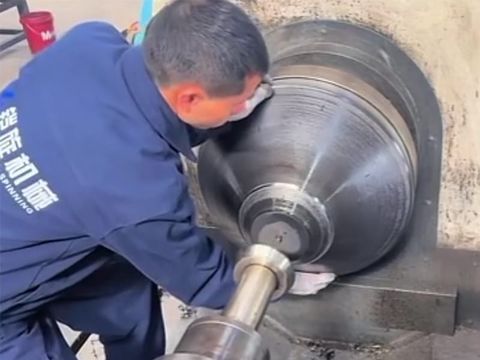
Stainless Steel Metal Spinning
Stainless steel spinning products are manufactured by metal spinning and CNC metal spinning — a seamless, cost-effective spin forming process that turns flat SS 304 and SS 316 blanks into corrosion-resistant, high-strength, hygienic components for food, medical, marine, and industrial use.
Introduction
Stainless steel spinning products are seamless, axially symmetrical components formed by metal spinning — a chipless, cold-forming process in which a flat stainless steel blank is rotated at high speed and progressively pressed over a rotating mandrel by a roller or tool. Also known as spin forming or metal turning, it belongs to the broader family of metal forming and sheet metal forming techniques, and it is one of the few that can shape a corrosion-resistant alloy without cutting, welding, or high-temperature joining.
The process is used across food processing, medical and pharmaceutical equipment, marine and offshore engineering, aerospace, energy, automotive, lighting, and architecture. Because stainless steel combines structural strength, long-term durability, and a self-healing passive oxide layer, it is one of the most frequently spun engineering materials in the world. This article explains how stainless steel spinning works, why the material suits the process, which grades are commonly spun, and what the resulting products deliver.
How Stainless Steel Spinning Works
In a typical metal spun operation, a flat circular stainless steel blank is clamped against a spinning mandrel on a CNC spinning machine and rotated at high speed. A forming roller applies controlled pressure, gradually deforming the metal over the mandrel — the tool that defines the final internal geometry. Because the metal is reshaped rather than removed, the process is a near-net-shape metal forming technique with very little material waste.
Metal CNC spinning is the automated form of the process. Instead of a skilled operator guiding the tool by hand, computer-controlled machines drive the rollers along a programmed toolpath, so wall thickness, diameter, and profile stay consistent from the first part to the thousandth. Stainless steel spinning can be carried out as cold forming or, for thicker or less ductile grades, hot forming, making the process suitable for everything from thin shells to thick-walled vessels.
The production sequence follows six controlled steps:
- Blank selection. A flat stainless steel blank is sourced in the grade and finish the application requires, with diameter and thickness calculated from the finished part to optimize material use.
- Blank mounting. The blank is clamped against the spinning mandrel, and the assembly is rotated at high speed.
- CNC spin forming. CNC-controlled rollers and tools apply controlled pressure, progressively deforming the metal over the mandrel into bowls, cups, housings, covers, reflectors, or decorative pieces.
- Work hardening. As stainless steel is deformed it work-hardens, so the finished metal spun part typically exhibits higher tensile strength than the original blank.
- Trimming and finishing. The spun part is trimmed to final height and diameter, then polished, brushed, passivated, or otherwise finished to the specified surface.
- Inspection. Dimensions, wall thickness, surface quality, and material certification are verified before shipping.
This controlled, automated sequence is what ensures uniformity, accuracy, and consistency across a production run of stainless steel components.
Main Features of Stainless Steel Spinning Products
1. Seamless, One-Piece Construction
Unlike fabrication methods that cut and weld multiple pieces together, stainless steel spinning forms the entire part from a single blank. The result is a seamless component with no welds, joints, or crevices — eliminating the weak points and contamination traps that welded fabrication introduces. For pressure vessels, food equipment, and anything that must be hygienic or leak-proof, this is the single most important benefit.
2. Work Hardening and High Strength
The spinning action refines the material's grain structure and work-hardens it, raising tensile strength and fatigue resistance. Spun components can therefore be both thin and strong, and they are often more durable than cast or stamped alternatives of the same material — adding performance at no extra material cost.
3. Corrosion Resistance Preserved
Unlike processes that involve high-temperature oxidation or joining, cold spin forming keeps the passive chromium oxide layer intact. The finished part retains the corrosion protection of the raw material, which is critical for marine, chemical, and food-contact service.
4. Excellent Surface Finish
Stainless steel polishes to a bright, mirror-like or brushed finish directly off the spinning machine, requiring no plating or painting. Specifying the target finish — mirror, brushed, or passivated — up front allows it to be built into the process and often reduces or eliminates secondary finishing.
5. Hygienic, Easy-to-Clean Surfaces
Non-porous, seamless stainless surfaces are easy to clean and sterilize, making spun components a decisive advantage in food, beverage, medical, and pharmaceutical applications where contamination control matters.
6. Wide Material Compatibility
Metal spinning accommodates a broad range of alloys, from stainless steel to aluminum, carbon steel, copper, brass, and titanium. For stainless steel spinning, austenitic grades such as 304 and 316 are preferred because their high elongation lets the metal flow smoothly over a mandrel during spin forming without tearing.
7. Material Efficiency
As a near-net-shape process, metal forming by spinning uses material efficiently, with utilization rates that can reach about 90% and far less scrap than machining. The blank is reshaped rather than cut away, preserving material integrity and reducing cost.
8. Low Tooling Cost
Because the process relies on a mandrel and rollers rather than expensive matched dies, tooling costs are significantly lower than deep drawing or stamping. This makes spinning economical for prototypes, low-to-medium volume custom runs, and full production alike.
9. CNC Precision and Repeatability
Modern CNC spinning lathes control rotation speed, roller pressure, and feed paths with computer precision, delivering tight tolerances, uniform wall-thickness control, and consistent quality across every part in a run. CNC toolpaths also compensate for the springback that stainless steel is prone to, and CAD/CAM integration streamlines the path from 3D model to finished component.
10. Design Flexibility and Rapid Prototyping
Spinning accommodates cylinders, cones, hemispheres, dished ends, funnels, and complex multi-contour profiles. Because design changes usually require only a new mandrel or a revised toolpath — not a new die — the process supports fast iteration and cost-effective prototyping during product development.
Typical Applications
Stainless steel spinning serves a broad cross-section of industry:
- Cookware, mixing bowls, hoppers, and vessels for food and beverage processing, in SS 304
- Sterilization and centrifuge bowls for medical and pharmaceutical equipment, in SS 304 or SS 316
- Exhaust components, housings, and pressure-vessel heads for marine and offshore use, in SS 316
- Pressure-vessel heads and tank ends for energy and chemical processing, in SS 316
- Nose cones, shrouds, and precision housings for aerospace and defense, in SS 304 or SS 316
- Hubcaps, trim, and wheel covers for automotive, in SS 304
- Lighting reflectors, shades, and architectural metalwork, in SS 304 or SS 316
Conclusion
Stainless steel and metal spinning are a natural match. Spinning exploits stainless steel's ductility to create seamless, strong, corrosion-resistant parts, while the material's durability and finish reward the process with products that last and look good doing it. Through CNC spin forming, manufacturers turn a flat stainless steel blank into a precise, uniform component in a fraction of the time and cost of welding, casting, or machining — with no welds, no seams, and minimal scrap.
Whether the goal is a hygienic food vessel, a marine-grade housing, a pressure-vessel head, or a polished architectural reflector, stainless steel spinning products deliver strength, integrity, and finish in a single seamless piece. We specialize in SS 304 and SS 316 spinning, producing seamless, precision metal spun components to the finish and tolerances your application requires.


