
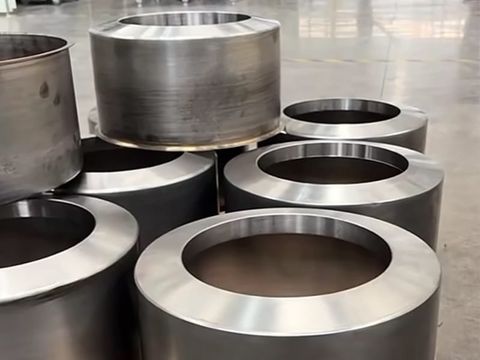
Specialty Metals Spinning
We delivers strong, precise, and rotationally symmetrical metal spun components with competitive cost efficiency. Leveraging advanced CNC metal spinning technology, we support complex geometries, large diameters, and demanding industrial applications — from prototype development to high-volume production. Our experienced engineering team works closely with customers to identify the most cost-effective manufacturing route, using CNC-controlled spinning, tube spinning, panel spinning, or manual spinning as the part requires.
What Is Specialty Metals Spinning?

Metal spinning — also called spin forming — is a chipless cold metal forming process. A flat metal disc or a preformed tube is clamped against a rotating mandrel and progressively shaped by rollers or hand tools until the blank takes the mandrel's contour. Because the metal is formed rather than cut, metal spun parts come out seamless, one piece, and rotationally symmetrical, with a continuous grain flow that follows the wall of the part instead of being interrupted by a weld.
Specialty metals spinning applies that same principle to the materials that are hardest to source, hardest to form, and hardest to replace: corrosion-resistant stainless steels, high-strength aluminum alloys, wear-resistant carbon steels, and exotic high-temperature alloys such as titanium, Inconel, Hastelloy and Monel.
Where stamping and deep drawing require dedicated press dies and long lead times, spin forming uses relatively low-cost mandrels and programmable CNC tool paths. That single difference is why metal spinning is so often the fastest and most economical way to turn a drawing into a finished, rotationally symmetrical component — and why it scales so smoothly from one prototype to a full production run.
Why Choose Metal Spinning Over Other Metal Forming Methods
- Seamless, one-piece strength. A metal spun part is formed from a single blank, so there is no weld seam to leak, crack, or fail under fatigue. This is decisive for pressure vessels, hygienic food equipment, and high-voltage electrical components.
- Low tooling cost. A spinning mandrel costs a fraction of a stamping die or deep drawing tool. Design changes usually mean a new tool path or a modest mandrel adjustment rather than a completely new die set.
- Material savings. Spin forming is a chipless process. Scrap is minimal compared with machining, and nested blanks can be laser cut to optimise yield.
- Work hardening. As the metal is formed over the mandrel it work-hardens, so a thinner wall can often deliver the strength of a heavier fabricated part.
- Design flexibility. Cones, hemispheres, domes, cylinders, flanged rings, parabolic and toroidal shapes are all achievable. Changes in diameter or profile are inexpensive compared with other metal forming methods.
- Scalable capacity. The same process supports single-piece prototypes and high-volume production runs, with consistent quality and repeatable tolerances across the whole batch.
Materials for Metal Spinning
Specialty metals spinning accommodates any ductile metal. The material mix below covers the great majority of industrial requirements, and custom alloys are quoted on request.
Aluminum Metal Spinning
Aluminum is the most widely spun specialty metal, thanks to its light weight, corrosion resistance, and excellent formability. Common grades include 1100 and 1060 (commercially pure, very formable), 3003 (good corrosion resistance and moderate strength), 5052 (the "anodise-quality" alloy with outstanding finish), 6061 (high strength and workability), and 7075 (very high strength for heavily stressed parts). Aluminum metal spinning is the default choice for lighting reflectors, fan casings, ventilation outlets, UAV and radar components, enclosures, and lightweight structural parts.
Stainless Steel Spinning
Stainless steel spinning covers the 300 series (304, 316L, 310S) and the 400 series. The austenitic 300 series delivers excellent corrosion resistance, hygiene, high-temperature stability, and a broad range of finishing options; the martensitic 400 series offers higher strength than carbon steel at a lower cost, with reduced corrosion resistance. Stainless steel is the material of choice for food and pharmaceutical equipment, chemical processing vessels, heat shields, and any application where cleanliness and longevity matter.
Mild Steel and Carbon Steel Spinning
Carbon steel and mild steel spinning produce rigid, durable, and economical parts that are easy to paint, coat, or galvanise. Common grades include Q235B for general fabrication and Q355B / Q355D high-strength steel for heavy-duty and low-temperature service. Typical applications include fan and blower housings, conveyor roller cones, machinery covers, buffer caps, base plates, and agricultural equipment.
Specialty Metals and Custom Alloys
Beyond the mainstream materials, specialty metals spinning opens the door to high-performance alloys that many fabricators simply will not touch:
- Copper and brass — for high-conductivity electrical components, heat-exchanger parts, architectural work, and decorative products.
- Titanium — a superior strength-to-weight ratio with outstanding corrosion resistance. Titanium has limited elongation at room temperature, so it is normally spun at elevated temperature by operators experienced with the material.
- Inconel, Hastelloy and other nickel alloys — for high-temperature, high-pressure, and severely corrosive environments such as gas turbine ducting, combustion liners, heat shields, and chemical plant hardware.
- Monel and other exotic alloys — for marine, seawater, and aggressive chemical service.
Metal Spinning Processes
CNC-Controlled Spinning
CNC metal spinning is the backbone of modern production. Programmed tool paths drive the roller through multiple forming passes, delivering high precision, repeatability, and consistent wall thickness part after part. CNC spinning is the preferred route for tight-tolerance work, large batches, and complex profiles that would be difficult to reproduce by hand.
Tube Spinning (Flow Forming)
Tube spinning, also known as flow forming, reduces the wall thickness of a tubular blank while extending its length over a rotating mandrel. It produces seamless, thin-walled, high-strength cylinders with excellent concentricity — ideal for hollow shafts, sleeves, pressure cylinders, and defence and aerospace tubular components.
Panel Spinning
Panel spinning forms large-diameter panels and shallow dished shapes economically, keeping the process cost-effective when the part is wide but relatively shallow. It is frequently used for architectural panels, large covers, and decorative elements.
Manual Spinning
Manual metal spinning remains the fastest and most economical option for prototypes, one-off parts, small batches, and designs that are still evolving. Skilled spinners combine hand tools with lathe rotation to produce complex, low-volume parts with minimal tooling investment.
Shapes and Geometries Achieved by Spin Forming
Conical Spinning Shapes
Conical spinning shapes are one of the most common metal spun geometries. Cones, truncated cones, and stepped variable-diameter cones are formed over a matched mandrel, with the wall thickness controlled pass by pass. Conical spinning is widely used for transition pieces, hoppers, nozzles, distributor cones, conveyor roller cones, and multi-layer stacked assemblies where each diameter must fit precisely into the next.
Hemispherical Geometries
A wide range of hemispherical geometries — hemispheres, domes, dished ends, and full spheres formed by joining two hemispheres — is produced by spin forming. Hemispheres and domes serve as tank ends, pressure vessel heads, lamp reflectors, satellite dishes, parabolic antenna components, and decorative architecture. Spheres add strength for demanding applications such as geological testing equipment, floats, and pressure housings.
Cylinders, Rolled and Welded Components
Metal spun cylinders deliver seamless walls for pressure vessels, piping, tubing, filter housings, and large containers. Where a part is too deep or too large to spin in a single piece, spun shells are combined with rolled and welded components — cylinders, rings, and flanges fabricated from rolled plate and joined by TIG or electron beam welding, with spun ends and dished heads welded on to complete the assembly. This hybrid approach keeps the seamless advantages of spinning where they matter most, while extending the size envelope of the process.
Metal Spinning Capabilities and Tolerance Control at KMS
KMS operates a 38-machine production fleet of CNC spinning lathes, tube spinning lathes, and laser cutting equipment, allowing us to match each part to the right machine rather than forcing it onto the largest one:
- CNC spinning lathes up to Ø2500 mm, covering large-diameter metal spinning for vessels, domes, housings, and fan casings.
- Tube spinning lathes for hollow, thin-walled cylindrical components.
- Material thickness up to 8 mm in stainless steel, 15 mm in carbon steel, and 20 mm in aluminum, depending on diameter and geometry.
- Dimensional tolerance typically ±0.1 mm to ±0.2 mm on diameter and height for CNC-spun parts, with tighter control achievable on critical features after negotiation.
- Surface finishing including mirror polishing to Ra ≤ 0.4 μm, deburring and edge rounding, anodising, sandblasting, wiredrawing, painting and zinc coating.
- Secondary operations including CNC machining, laser cutting, TIG and electron beam welding, and assembly.
Quality is managed under an ISO 9001 quality system, with linear tolerances controlled to GB/T 1804-m and geometric tolerances to GB/T 1184, 100% inspection on critical fit surfaces, and CMM verification of key profiles. For demanding programmes, full first article inspection reports and material certificates are available.
Industries That Rely on Specialty Metals Spinning
- Aerospace and defence — nose cones, fairings, cowlings, transmitter and receiver shells, engine housing components, and pressure vessels where weight, strength, and reliability are all critical.
- Power and high-voltage electrical — GIS aluminum assemblies, UHV transmission shields, copper tail pipes, bushings, and enclosures that demand a clean internal surface and stable conductivity.
- Petrochemical and chemical processing — nickel-alloy cavity sleeves, covers, and stainless steel containers for corrosive and high-temperature service.
- Food, beverage and pharmaceutical — hygienic hoppers, bowls, kettles, mixing vessels, and 180-litre class containers with polished, residue-free interiors.
- Mechanical engineering and heavy industry — end sockets, buffer caps, fixed bases, centrifugal discs, heavy-duty back plates, and anti-deformation components for mining, port, and conveying equipment.
- Agricultural machinery — wear-resistant cones, trays, and chutes that stand up to abrasive grain, ore, and fertiliser.
- Construction, lighting and architecture — ventilation outlets, fan casings, distribution rings, lamp reflectors, and decorative spun domes.
- Medical devices, automation and electronics — instrument housings, shields, and rotors requiring tight tolerances and clean surfaces.
Cost Efficiency: The Metal Spinning Advantage
Metal spinning is frequently the most cost-effective metal forming solution for rotationally symmetrical parts, and the savings come from several directions at once: low mandrel cost instead of expensive dies, minimal scrap because the process is chipless, fewer secondary operations because parts come off the lathe seamless and close to final form, and fast changeover that makes short runs and design iterations affordable. When volumes grow, CNC spinning keeps unit cost predictable while holding the same tolerances — so the same process that validated the prototype also carries the production programme.
Engineering Collaboration: From Drawing to Production Part
The most cost-effective solution is rarely the most obvious one. Our engineering team reviews the drawing, the material, the tolerance stack-up, and the annual volume together, then recommends the process route that delivers the required performance at the lowest total cost — CNC-controlled spinning, tube spinning, panel spinning, or manual spinning. Where a design can be simplified for manufacturability, we say so early, while changes are still cheap. Feasibility feedback and quotation normally follow within 24 hours of receiving a drawing.
With flexible production capacity, KMS scales seamlessly from prototype development to high-volume production while maintaining consistent quality and tight tolerances — delivering strong, precise, rotationally symmetrical metal spun components on schedule.


