
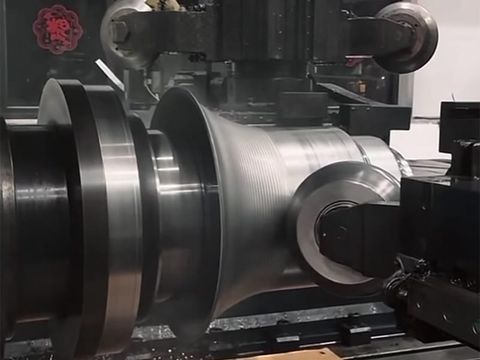
CNC Metal Spinning for New Energy Vehicle (NEV)
Metal spinning of aluminum motor housings for new energy vehicles — how scaled-up CNC metal spinning and spin forming deliver larger, seamless, lightweight EV drive components with lower tooling cost and tighter tolerances.
Introduction
The aluminum motor housing is one of the most demanding rotationally symmetrical parts in a new energy vehicle (NEV) powertrain. It must be light enough to protect driving range, stiff enough to hold the stator and rotor in perfect alignment, thermally efficient enough to move heat out of the drive unit, and completely leak-free for the life of the vehicle. Metal spinning, also called spin forming or rotary forming, is a metal forming process that shapes a flat aluminum disc — or a pre-formed tube — over a rotating mandrel, turning a single blank into a finished housing instead of welding together several castings and stampings.
As electric vehicle platforms move toward higher power densities and longer range, the components around the e-motor have grown larger and more integrated. The NEV industry is rapidly advancing toward lightweight construction, higher efficiency, and enhanced reliability, and metal spinning has scaled up to match it. This article explains how CNC metal spinning is used to produce aluminum motor housings for new energy vehicles, why scaled-up spin forming matters, and what it delivers in cost, precision, and sustainability. It follows one project with a leading EV manufacturer developing a next-generation platform built around extended driving range and a high-performance powertrain.
How Aluminum Motor Housing Spinning Works
In a typical metal spinning operation, a circular aluminum blank is clamped against a mandrel that defines the internal bore and end-wall geometry of the housing. The mandrel rotates at controlled speed while CNC-controlled rollers apply axial and radial force in a sequence of passes, gradually wrapping the blank into a cylindrical shell with an integrated end wall, flange, and mounting interfaces. A good starting alloy — 5A02, 5052, or 6061 aluminum — is chosen for ductility, corrosion resistance, and thermal conductivity.
For aluminum, the process normally runs cold. Cold forming is desirable because it work-hardens the metal as it is shaped, raising tensile strength and fatigue resistance without adding weight. Where wall reduction must be aggressive, shear spinning (also known as flow forming) thins the wall while holding the diameter, which allows a stiff, thicker integral flange and a thinner active shell in one part.
The real story of recent years is scale. Vertical spinning machines now form steel blanks up to 32 mm thick and workpieces up to 1,500 mm in diameter, using two cross supports that apply roughly 1,000 kN axially and 800 kN radially, with up to six forming rollers that can be set at any angle in 5° increments. Horizontal CNC lathes routinely handle blanks up to 2.4 m. Because aluminum is more ductile and forms at lower forces than steel, this capacity headroom means deeper, larger housings can be produced in fewer passes with less risk of wrinkling or buckling.
Key Features of Aluminum Motor Housing Metal Spinning
- Seamless, One-Piece Construction Because the housing is formed from a single blank rather than welded from several pieces, it has no seams, no weld heat-affected zones, and no joints to leak or crack. Seamless metal parts are inherently stiffer and more reliable under vibration, which matters in a component bolted directly to an e-motor.
- Scaled-Up Diameter and Depth Capability A generation ago, large housings were beyond the reach of most spinning shops. Today, heavy-duty spinning cells with high forming force and multi-roller tooling shape the larger, deeper aluminum shells that modern drive units require — in fewer passes and with fewer intermediate anneals.
- Lightweighting Without Losing Strength Aluminum spun housings are typically far lighter than cast-iron or steel equivalents, and the forming process allows thinner walls where loads allow. On a next-generation EV platform, that weight saving feeds directly into extended driving range and improved efficiency.
- Work Hardening for Powertrain Duty Cycles The plastic deformation of spin forming re-aligns the metal's grain structure, increasing tensile strength, hardness, and resistance to fatigue. Spun aluminum housings therefore handle the repeated thermal and vibration cycles of a high-performance powertrain better than their as-cast counterparts.
- Tight Tolerances and Concentricity Modern CNC metal spinning holds tolerances down to roughly ±0.1 mm on critical diameters, with better roundness and concentricity than welded fabrications. This precision keeps stator-to-rotor air gaps consistent, which directly affects motor efficiency and noise.
- Excellent Thermal Performance Aluminum's high thermal conductivity helps the housing act as a heat sink and as the inner wall of the cooling jacket. A seamless, uniformly thick spun shell conducts heat more predictably than a part with welds, porosity, or variable cast thickness.
- High Material Utilization and Low Tooling Cost Because metal spinning reshapes rather than cuts metal, material utilization commonly reaches 85–95%, compared with 30–60% for machining or stamping. Tooling is a mandrel and rollers rather than matched dies, so low tooling cost and fast setup apply even to new, unproven platform geometries.
- Design Freedom for Cooling and Interfaces Multi-contour profiles, flanges, steps, and recessed mounting faces can be formed in a single integrated part. Combining conventional spinning with flow forming lets engineers tune wall thickness locally — thicker at bearing seats, thinner in the active shell.
- Faster Development for New EV Platforms Changing a mandrel or a CNC tool path is quick and inexpensive, while changing a die is not. For manufacturers iterating on prototypes before committing to series production, metal spinning supports rapid design cycles at very low risk.
- Sustainability Aligned with NEV Goals Spinning is a cold, chipless, near-net-shape process with low energy demand and minimal scrap, and aluminum scrap is fully recyclable. For EV makers tracking lifecycle emissions, a metal spun housing is a measurable step toward closed-loop, low-carbon manufacturing.
Typical Applications
Thanks to these characteristics, metal spinning is used to manufacture:
- Aluminum and aluminum-alloy motor housings and e-motor casings
- Rotor and stator carriers and end covers for electric drive units
- Battery enclosure shells, trays, and cooling-jacket components
- Inverter housings, shields, and heat-dissipating enclosures
- Transmission and reduction-gear housings with integrated flanges
- Wheel rims and hub-related forms, and brake and heat-shield parts
- Charging-equipment enclosures, busbar housings, and connector bodies
Conclusion
Aluminum motor housings sit at the intersection of everything the new energy vehicle industry is trying to achieve: lighter weight, higher efficiency, and greater reliability. Scaled-up metal spinning — heavy-duty CNC spin forming with multi-roller tooling — now produces the larger, deeper, seamless housings that modern electric drive units demand, while keeping tooling cost low and material utilization high. The result is a single-piece, work-hardened, dimensionally precise housing that is quicker to develop, cheaper to tool, and easier to recycle than a welded or cast alternative. Whether you are validating a prototype or scaling a next-generation platform into series production, partnering with an experienced metal spinning manufacturer turns those requirements into repeatable, cost-effective parts.


