
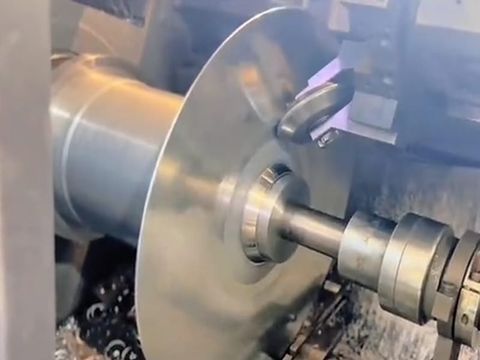
Precision CNC Metal Spinning for Stainless Steel Dome Covers
Precision CNC metal spinning of custom stainless steel dome covers delivers seamless, weld-free enclosures with ultra-high dimensional accuracy, mirror-quality finish, and long-term reliability in high-end industrial screening equipment.
Introduction
Industrial screening equipment — vibratory separators, rotary sifters, and high-capacity classification machines used across mining, chemical processing, and bulk material handling — depends on enclosure components that protect the working mechanism while surviving years of vibration, abrasive dust, and humid or chemically aggressive atmospheres. The dome cover that acts as the upper sealing and protective enclosure of a screening machine is among the most demanding of these parts: it must fit the machine body exactly, seal it completely, and look as good as it performs. This article describes how metal spinning — also called spin forming or rotary metal forming — was applied to produce a custom stainless steel spun dome cover for a Singapore-based screening equipment manufacturer recognised as a global leader in material classification systems.
How CNC Metal Spinning Forms a Stainless Steel Dome Cover
Metal spinning is a chipless, cold-forming process. A flat circular blank — laser-cut from stainless steel sheet — is clamped against a rotating mandrel, the tool that defines the finished internal contour, and spun at high speed. A CNC-controlled roller then applies localised pressure in programmed passes, progressively laying the metal down over the mandrel until the blank becomes a seamless, axially symmetrical shell. No material is cut away, so a metal spun dome retains the full integrity of the original sheet.
Several variants of the spin forming process are combined to reach a given dome geometry. Conventional spinning builds the profile with minimal wall-thickness change; shear spinning (flow forming) thins the wall deliberately to produce a stronger, lighter dome; and multi-step deep spinning handles taller contours in successive passes. Work is usually carried out cold, and for less ductile alloys or heavy sections with localised heat. Prototypes can still be hand-spun, but a precision component such as a screening machine dome cover is produced on CNC metal spinning lathes, where every pass, feed rate, and roller force is programmed and repeatable.
After forming, the dome is trimmed to its final diameter and height, then polished and inspected. In a full-service custom metal spinning workflow, laser cutting, trimming, mirror polishing, passivation, and dimensional verification take place under one roof — a decisive advantage when the part carries a demanding surface and tolerance specification.
Key Features of a Spun Stainless Steel Dome Cover
1. Ultra-High Dimensional Precision for Perfect Assembly Fit
The most critical requirement was dimensional accuracy: the dome must seat on the screening machine body without gaps, shimming, or rework. Because CNC rollers follow a programmed tool path against a precision mandrel, spun diameters and heights are held within roughly ±0.1 mm on critical dimensions, referenced to standards such as GB/T 1804-m for linear tolerances and GB/T 1184-K for geometric tolerances. Mating flanges, rim concentricity, and the seating face are 100% inspected, with CMM verification on critical profiles — so the cover drops into place on the first attempt, every time.
2. Seamless, Weld-Free One-Piece Construction
A spun dome is formed from a single blank, so it has no longitudinal or circumferential weld seams. For an upper sealing enclosure this is fundamental: welds introduce leak paths, crevice-corrosion sites, residual stress, and fatigue initiation points — all unacceptable on a machine that vibrates continuously. Removing welding also removes the post-weld grinding and re-polishing that would otherwise disturb the finish and distort an already precise part.
3. Mirror-Quality Surface Finish
The customer specified a mirror-quality finish, both for appearance and for cleanability. After spinning, the dome is polished — including electrolytic polishing for stainless steel — to a surface roughness of Ra ≤ 0.4 µm, free of spinning marks, scratches, and tool chatter. A mirror surface sheds dust and residues instead of trapping them, wipes down easily, and gives the finished machine the premium look expected of high-end equipment. Controlled roller pressure also preserves the passive surface layer, so the shine is durable rather than cosmetic.
4. Long-Term Reliability in Harsh Industrial Environments
Screening equipment operates around the clock in mines, chemical plants, and bulk terminals, where humidity, washdown, salt-laden air, and aggressive process media are routine. Austenitic grades such as SUS304 and SUS316 combine a self-healing chromium oxide passive layer with high toughness, so a metal spun dome resists rust, staining, and pitting over a long service life. With no weld heat-affected zones to become preferential corrosion sites, that resistance stays uniform across the whole component.
5. Natural Balance and Vibration Resistance
Spin forming distributes material evenly around the axis of rotation, so a metal spun dome is inherently well balanced and truly circular. On a machine that vibrates at high frequency, this symmetry keeps dynamic loads low and prevents the cover from working loose or generating noise. Uniform wall thickness further avoids local resonance, contributing to quieter, more stable operation than a welded or fabricated alternative.
6. Work-Hardened Strength Without Extra Weight
As stainless steel flows over the mandrel, its grain structure realigns and the material work-hardens, raising tensile strength, impact resistance, and fatigue life. The finished dome is therefore stronger than the flat sheet it came from — strength gained at no extra material cost. This allowed a thinner, lighter cover with no loss of stiffness or sealing performance, easing handling during assembly.
7. Corrosion Resistance and Cleanability in One Material
Stainless steel is non-porous, seamless, and hygienic, which suits screening machinery used in food, pharmaceutical, and fine-chemical processing as well as in heavy duty. The spun cover can be supplied passivated to restore its passive layer after forming, and it needs no plating or painting — one material satisfies corrosion resistance, hygiene, and appearance at once.
8. Low Tooling Cost and Rapid Design Iteration
Metal spinning shapes parts over a mandrel rather than between matched dies, so tooling investment is a fraction of that required for deep drawing or stamping. When the customer needed to adjust the dome's profile, rim, or height for a new machine model, the change was realised by refining the mandrel or editing the CNC tool path — not by ordering a new die set. That low-cost agility keeps bespoke, low-volume covers commercially viable.
9. Repeatable Quality at Production Scale
CNC spin forming with in-process monitoring and statistical process control keeps wall thickness, diameter, and profile within specification from the first piece to the last. Every unit in a run behaves identically, so the assembly line receives components that fit the same way every time. The process that proved the design as a single prototype scales directly to serial supply — a one-stop metal forming route from drawing to a ready-to-install enclosure.
Typical Applications
Metal spun stainless steel domes and related seamless enclosures are widely used for:
- Upper sealing and protective dome covers for vibratory separators, rotary sifters, and classification machines
- Vibratory bowl feeders and centrifugal disc shells for automated parts feeding
- Industrial fan housings, impellers, and axial flow fan components
- Pressure vessel heads, tank heads, and dished ends
- Food-grade hoppers, bowls, kettles, and 180 L food and chemical containers
- Chemical and pharmaceutical vessels requiring hygienic, seamless interiors
- Lighting reflectors, decorative spun domes, and architectural metalwork
- High-voltage electrical enclosures and clean-cavity shielding components
- Mining and heavy-duty conveying components such as back plates and conical parts
Conclusion
For a global screening equipment manufacturer, the stainless steel spun dome cover had to satisfy four non-negotiables at once: ultra-high dimensional precision for perfect assembly fit, a seamless weld-free structure, a mirror-quality surface finish, and long-term reliability in harsh industrial environments. CNC metal spinning meets all four in a single one-piece component — precision held to ±0.1 mm on critical dimensions, no weld seams to crack or corrode, a polished Ra ≤ 0.4 µm surface, and work-hardened corrosion-resistant stainless steel built to last. Combined with low tooling cost, fast design iteration, and repeatable quality from prototype to production, spin forming delivers a metal spun enclosure that is more reliable, more consistent, and more cost-effective than a welded fabrication. If you need a seamless stainless steel dome cover or a similar rotationally symmetrical part for your own equipment, an experienced metal spinning manufacturer can move from your drawing to a qualified sample quickly.


