
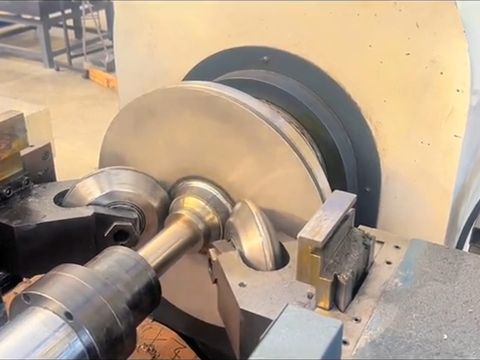
Advanced Metal Spinning
Metal spinning, also known as spin forming or metal turning, is a metal forming process that transforms flat circular blanks or tubes into seamless, axially symmetric parts using rotational motion and localized roller pressure. As industries demand ever-larger, lightweight, and structurally sound components, advanced metal spinning is evolving from a traditional craft into a high-tech, scalable manufacturing solution.
Why Scale Up Metal Spinning?
Large seamless components — pressure vessels, aerospace nose cones, turbine housings, large cylinders, and hemispherical domes — are increasingly specified where welds and joints would compromise structural integrity. Compared with deep drawing, hydroforming, forging, and casting, metal spinning offers:
- Seamless construction — no welds, no porosity, superior mechanical properties
- Low tooling cost — soft or hard tooling, rapid prototyping, easy design changes
- Minimal material waste — near-net-shape forming
- High flexibility — cost-effective for both prototypes and large production runs
Key Innovations Driving Advanced Metal Spinning
1. CNC and Process Automation
CNC spin forming machines have turned metal spinning into a data-driven, repeatable process. Pre-programmed roller paths, feed rates, and multi-pass strategies precisely control thinning and springback, while real-time feedback enables in-process correction. Integrated CAD/CAM simulation predicts material flow digitally before the first blank is ever spun, dramatically shortening development cycles.
2. Machines Built for Large, Thick Parts
Next-generation spinning equipment now handles parts up to 2,500 mm in diameter and blank thicknesses of 10–15 mm in stainless steel, mild steel, and aluminum. High-force vertical spinning machines deliver the axial and radial forces that conventional lathes cannot, making large-format, thick-walled spun components commercially viable.
3. Hot Spinning and Advanced Materials
Difficult-to-form alloys — titanium, magnesium, Inconel, and metal matrix composites — are increasingly processed via hot spinning with precise temperature control, expanding metal spun parts into aerospace, energy, and medical markets once served only by forging.
4. Smart Manufacturing and Sustainability
Finite element analysis (FEA) and machine learning are being applied to real-time process control and toolpath optimization, reducing defects such as wrinkling and cracking. Sustainable practices, including recycled aluminum feedstock and energy-efficient hot-spinning cells, align metal forming with modern environmental goals.
The Road Ahead
Advanced metal spinning combines ancient craft with modern precision: larger capacities, smarter control, and new materials. For manufacturers seeking seamless, high-strength, large-diameter components with low tooling investment and minimal waste, spin forming is becoming the strategic metal forming process of choice.


