
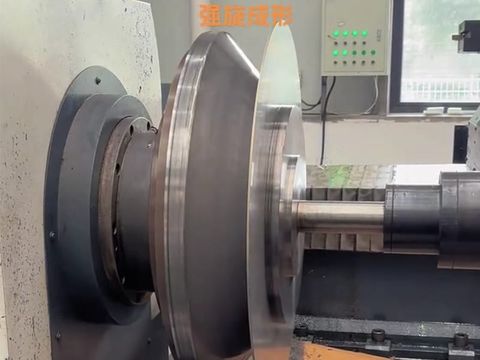
Shear Spinning
Shear spinning (shear forming) and flow forming (tube spinning) are precision metal forming processes that reduce wall thickness while producing strong, lightweight, rotationally symmetrical parts. From cones and domes to high-precision tubular components, these metal spinning techniques deliver excellent surface finish and scalable production from prototypes to mass manufacturing.
What Is Shear Spinning?
Shear spinning, also called shear forming, shapes sheet metal over a rotating conical mandrel, typically on a conventional spinning machine. In this metal spinning process, the wall thickness of the blank is intentionally reduced while the original blank diameter is maintained. The roller forms the blank while applying compressive force, stretching the material in a single pass.
The mechanics of shear spinning follow the sine law: the final wall thickness equals the initial blank thickness multiplied by the sine of the cone's half-angle. Shear angles typically range from 12° to 18°, with a maximum of around 80°. Because of this geometric constraint, purely cylindrical shapes cannot be produced by shear forming alone — vertical walls would require a 0° shear angle. Shear spinning therefore specializes in conical, tapered, and contoured components with enhanced strength-to-weight ratios.
Key characteristics of the shear spinning process include:
- Single-pass forming with high axial forces for efficient production
- Controlled wall thinning that produces lightweight yet strong parts
- Work hardening that increases yield strength and fatigue resistance
- Excellent suitability for hard-to-deform materials such as stainless steel, titanium, and Inconel alloys
What Is Flow Forming?
Flow forming, also known as tube spinning, extends the principles of shear spinning to tubular blanks. The process reduces wall thickness while increasing the length of a tube, using dedicated flow forming equipment fitted with multiple rollers that apply localized radial pressure. The result is a rotationally symmetrical hollow part with precisely controlled dimensions.
Compared with conventional metal spinning, flow forming offers:
- Significant wall reduction — typically 50–80% — with superior uniformity
- Tailored thickness profiles, such as thicker ends and thinner centers
- Exceptional mechanical properties from intense work hardening
- Tight dimensional tolerances and excellent surface finish
- Ideal economics for thinner-walled, longer cylindrical components
To achieve the best results, tubular blanks for flow forming should exhibit low flow stress, a high tensile-to-yield strength ratio, high elongation, and high reduction in area. Ductile materials — including aluminum, stainless steel, carbon steel, copper, and high-performance alloys — are all common candidates for this spin forming method.
Shear Spinning vs. Conventional Spinning
Metal spinning as a whole is classified into three main types, each defined by its effect on wall thickness:
- Conventional spinning — maintains the blank's original wall thickness; ideal for shallow, axisymmetric parts such as bowls, domes, and lamp reflectors, with flexible multi-pass forming.
- Shear spinning — reduces wall thickness through shear forces; limited to conical and tapered shapes but delivers superior strength-to-weight performance.
- Flow forming (tube spinning) — reduces wall thickness while elongating tubular blanks; the choice for high-precision cylindrical and hollow components.
Selecting the right process depends on part geometry, thickness targets, material behavior, and production volume — an evaluation best made with an experienced metal forming engineering team.
Applications of Shear Spinning and Flow Forming
Shear spinning and flow forming enable economical production of a wide variety of products across many industries:
- Household and commercial goods — vases, bowls, cones, kettles, ladles, and funnels
- Industrial equipment — blower housings, fans, filters, nozzles, and venturis
- Pressure and containment — domes, drums, and seamless pressure vessels
- Aerospace and automotive — lightweight conical structures, jet engine cones, wheel hubs, and rocket casings formed from high-strength alloys
These processes scale smoothly from one-off prototypes to high-volume mass production, with mandrel-based tooling that keeps costs low and design changes simple.
Benefits at a Glance
- High precision — tight tolerances and uniform wall thickness, even on complex contours
- Excellent surface finish — smooth spun surfaces often require little or no secondary finishing
- Material efficiency — a chipless metal forming process with minimal waste
- Enhanced strength — work hardening improves mechanical properties without heat treatment
- Cost-effective tooling — far cheaper than stamping dies, ideal for both short runs and large volumes
Conclusion
Shear spinning and flow forming represent the high-precision end of the metal spinning family. By deliberately controlling wall thickness — thinning conical blanks in shear forming or elongating tubes in flow forming — manufacturers gain lightweight, seamless, high-strength components that other metal forming methods cannot match economically. Whether your project calls for a spun cone, a flow-formed tube, or a fully engineered metal spun assembly, these processes offer a proven path from prototype to production.
