
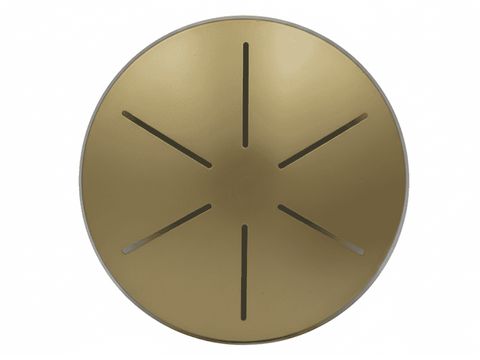
Custom Commercial Lighting Products
Precision-engineered custom commercial lighting solutions manufactured through advanced metal spinning and metal stamping technologies. This article explains how we turns flat metal blanks into durable reflectors, shades, and fixture housings — covering the spin forming process, the materials that matter most, the full range of spun lighting shapes, and the quality standards behind every metal spun part.
Where Optical Performance Meets Metal Forming
Commercial lighting is one of the most demanding applications in metalworking. A reflector that is a fraction of a millimeter off its intended profile will scatter light instead of concentrating it; a shade with an uneven wall will show a visible seam under a hard spotlight; a housing that cannot hold its shape in a humid or coastal environment will fail long before its LED source does.
That is why the quality of a luminaire is decided long before assembly. It is decided at the moment a flat metal blank is shaped into a reflector, a shade, a trim ring, or a fixture body. At KMS, that moment is driven by two complementary technologies — metal spinning and metal stamping — supported by decades of experience in metal forming, CNC equipment, and skilled technicians who understand what lighting manufacturers actually need.
From custom lighting fixtures to precision-engineered reflectors, we deliver complete metal forming solutions for commercial lighting applications.
What Makes a Commercial Lighting Component "Custom"?
Standard catalogue reflectors cover a handful of beam angles and sizes. Real projects rarely fit a catalogue. Architectural lighting designers need profiles matched to a specific optic. Industrial and sports lighting projects need large-diameter reflectors capable of handling high-output lamps. Retail and hospitality projects need decorative metal shades in brass or copper with a finish that survives daily handling.
A custom commercial lighting component is therefore defined by four variables that must all be controlled at once:
- Geometry — the exact optical profile, flange configuration, and mounting interface.
- Material — the alloy and thickness that deliver the required reflectivity, strength, and corrosion resistance.
- Finish — polished, brushed, painted, anodized, or plated, matched to the visual and environmental brief.
- Repeatability — the same part, within tolerance, on the first article and on the ten-thousandth.
Custom metal spinning and metal stamping are the two most cost-effective ways to satisfy all four.
Why Metal Spinning Is the Preferred Process for Lighting Reflectors
Metal spinning — also called spin forming, metal turning, or simply spinning — is a chipless cold-forming process. A flat circular metal blank is clamped against a mandrel on a spinning lathe and rotated at high speed while a roller or tool presses the material progressively over the mandrel until it takes the shape of the form. Nothing is cut away; the metal is reshaped.
For lighting components, that single characteristic produces five advantages that welded or machined alternatives cannot easily match.
Seamless, Symmetrical Geometry
Because the part is formed from one piece of material, a metal spun reflector has no welds, no joints, and no riveted seams to interrupt the light path. Spun parts are inherently axially symmetric, which is exactly the geometry optical design demands — light distribution stays even across the full aperture.
Optical Consistency Part to Part
Every spun reflector follows the same toolpath over the same mandrel. Wall thickness, radius, and profile remain consistent from the prototype to the production run, so the photometric performance of the finished luminaire does not drift between batches.
Low Tooling Cost and Fast Prototypes
Mandrels and spinning tools are simple and inexpensive compared with stamping dies or casting molds. That makes spinning the most economical route for prototypes, design iterations, and low-to-medium volume production — a decisive advantage when a lighting range is still being refined.
Work Hardening for Strength at Thin Gauges
The rotational forming action work-hardens the metal, raising its tensile strength without additional heat treatment. Designers can therefore specify thinner, lighter reflectors and shades while keeping the stiffness the application requires.
Near-Zero Material Waste
Spinning generates almost no scrap, which keeps material cost low and supports more sustainable production — an increasingly common requirement in lighting tenders.
Metal Stamping: The Perfect Complement to Metal Spinning
Not every lighting part is round. Trim rings, brackets, mounting plates, end caps, and decorative perforated panels are typically flat or shallow forms, and these are produced far more economically by metal stamping.
Stamping shapes sheet metal between a punch and a die. It is fast, highly repeatable, and ideal for volume production of flat or shallow components with pierced holes and formed features. Where a lighting fixture needs both a spun reflector and a stamped mounting frame, producing both under one roof removes a whole layer of coordination, tolerance stack-up, and logistics cost.
That is the practical value of a manufacturer offering both spinning and stamping: the round, optical-critical parts are spun; the flat, functional parts are stamped; and both arrive at assembly matched to the same drawing.
Materials for Custom Commercial Lighting
The material specification determines reflectivity, weight, corrosion behaviour, and finish options. We routinely process five material families for commercial lighting work.
Aluminum — the Workhorse of Lighting Reflectors
Aluminum is the most commonly used material in our commercial lighting projects, and for good reason. It offers excellent reflectivity, is lightweight enough to reduce the load on ceiling structures and mounting hardware, resists corrosion through a naturally self-renewing oxide layer, and takes polishing, anodizing, and painting exceptionally well. Typical commercial lighting work uses aluminum in the 1.0–2.0 mm range, with alloys such as 1100, 3003, 5052, and 6061 chosen according to formability and finish requirements.
Brass
Brass is stronger than copper and offers a similar combination of easy formability, good conductivity, and warm decorative appearance. It is the material of choice for high-end interior fixtures and visible architectural shades where the metal itself is part of the design intent.
Copper
Copper is highly ductile, naturally resistant to tarnishing, non-magnetic, and visually striking. Spun copper shades and hemispheres give premium luminaires a distinctive patina that develops gracefully over time, and copper's thermal conductivity helps manage heat close to the light source.
Stainless Steel
Stainless steel delivers the highest combination of strength and corrosion resistance, making it the specification for outdoor, marine, food-processing, and industrial lighting environments. Grades such as 304 and 316 hold their finish in aggressive conditions and can be polished to a bright, durable surface.
Cold-Rolled Steel
Cold-rolled and carbon steel provide excellent rigidity and cost efficiency for structural housings, mounting plates, and trim components. Parts are usually protected with powder coating, painting, or zinc plating, and their strength allows more aggressive stamped forming.
Spun and Stamped Lighting Shapes We Produce
Metal spinning handles a wide family of rotationally symmetric profiles, while stamping covers the flat and shallow features around them. Our commercial lighting production regularly includes the following shapes:
- Dished — a shallow concave profile that produces broad, even beam distribution in downlights and panel luminaires.
- Domed — a full, rounded crown suited to high-bay, post-top, and area luminaires.
- Domed with flange — a domed body finished with a flat mounting rim, allowing easy sealing and fastening into a fixture housing.
- Flanged — a cylindrical or conical spun body terminated by a straight flange for mechanical fixing and optical cutoff control.
- Flanged and fluted — a flanged form with decorative or light-directing flutes, common in architectural pendants.
- Flanged, dished, and fluted — a combined profile that merges the mounting flange, the optical dish, and the fluted texture in a single seamless piece.
- Hemisphere — a true half-sphere used for globe luminaires, sphere-based decorative fixtures, and seamless reflectors with mirror finishes.
- Semi-elliptical — a shallower ellipsoidal profile that provides controlled beam distribution with a lower overall height.
- Trumpet — a flared, bell-like curve frequently specified for wall-mounted and indirect lighting where the reflector is visible.
Each of these forms can be produced in aluminum, brass, copper, stainless steel, or cold-rolled steel, and finished to the project's specification.
From CAD to Container: How a Custom Lighting Part Is Made
A typical commercial lighting project moves through a predictable sequence:
- Design review. Customer drawings or CAD files are reviewed against spinning capability — symmetry, wall thickness, radii, flange design, and material formability. Working geometry is confirmed before any tooling is cut.
- Tooling and blank preparation. A mandrel is machined to the optical profile, and flat blanks are laser-cut to the calculated diameter and thickness.
- CNC spin forming. CNC metal spinning drives the rollers along a programmed path, forming the blank over the mandrel with precise control of speed, feed, and force. This is where repeatability is guaranteed.
- Stamping and secondary forming. Flanges, trimming, piercing, and mating components are produced on stamping and press equipment, then fitted to the spun body.
- Finishing. Parts are deburred, polished, brushed, anodized, painted, zinc-plated, or powder-coated according to the specification.
- Inspection and packaging. Critical dimensions are verified against the drawing, and finished reflectors are protected for shipment to avoid surface damage in transit.
Quality Control: Consistency You Can Specify
Consistency is what separates a sample from a supply relationship. Our production follows an ISO 9001-based quality management system, with incoming material verification, in-process dimensional checks, and final inspection on critical features. Tolerances are held with CNC-controlled toolpaths, and finished components are checked against the customer drawing before shipment — so what arrives is what was approved. For metal spun optical parts, that discipline is what keeps beam performance stable across an entire production run.
Serving the Commercial Lighting Industry
Our spun and stamped components are used across the lighting spectrum:
- Commercial and architectural lighting — reflectors, shades, trims, and decorative elements for offices, retail, hospitality, and public buildings.
- Industrial and high-bay lighting — large-diameter reflectors and housings for warehouses, factories, and sports facilities.
- Outdoor and street lighting — weather-resistant spun housings and covers in aluminum and stainless steel.
- Specialty lighting — photography and studio lamp covers, medical and surgical reflectors, and stage luminaires.
- Custom fixtures — bespoke metal shades, ceiling domes, canopies, and pendants produced to designer drawings.
Why Choose Us
We combine metal spinning and metal stamping under one roof, which means a single supplier for round optical parts and flat structural parts, one drawing revision cycle, and one quality standard. Our capabilities include a large fleet of CNC metal spinning lathes covering small-diameter decorative work through to large reflectors, in-house tooling and die production, and decades of accumulated knowledge in metal forming for lighting applications.
Backed by CNC metal spinning, skilled technicians, and decades of experience, we deliver lighting components that meet exact design specifications and performance standards — in aluminum, brass, copper, stainless steel, and cold-rolled steel, in the quantities your project requires.
Conclusion
A commercial lighting product is only as good as the metal forming behind it. Metal spinning delivers the seamless, symmetrical, work-hardened geometry that optical performance depends on, while metal stamping supplies the flat and shallow parts that make a complete fixture. Together, they let designers specify exactly the reflector profile, material, and finish each project needs — without the tooling cost and lead times of casting or multi-draw stamping.
If you are developing a new luminaire, refining an existing reflector, or sourcing replacement components for a commercial lighting range, our team is ready to review your drawings and recommend the most efficient route — spin forming, stamping, or both.
