
Stainless Steel Spinning: Seamless 304 Cones & Funnels
A stainless cone with one weld has a corrosion site, a pickling step and an inspection on it. Spinning removes all three.
Metal Spinning Process
Stainless steel is easy to weld and hard to weld well. A 304 cone closed with a longitudinal seam carries a heat-affected zone on both sides of the joint: the passive layer is gone, filler dilution pulls the local chemistry away from 18/8, and the joint has to be pickled, passivated and inspected before shipping. The steel is fine. The seam is the part that fails.
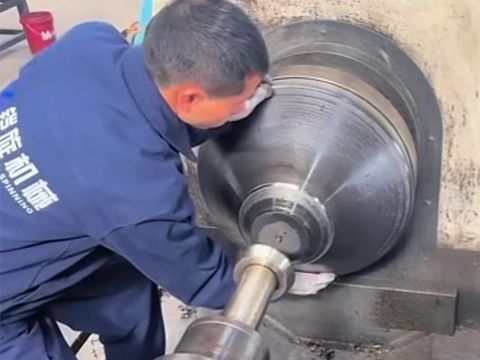
Metal spinning removes the seam by removing the joint. A flat blank is clamped against a rotating mandrel and a roller presses it onto the profile over four to eight passes. Nothing is cut and nothing is added: the wall compresses, flows and work-hardens in place, so the shell leaves the lathe as one piece, with no weld line and no heat-affected zone. The same compression refines the grain along the profile, which is why spun metal parts run harder than the same gauge welded from sheet.
The numbers move with the process: metal spinning holds diameter and profile at ±0.3 mm, as-spun surface at Ra 0.8–1.6 µm, and the envelope reaches 2,400 mm across, 10 mm in stainless, covering funnels, cones, hemispheres and dished ends. Per-part cost is where metal forming routes split: one mandrel replaces a die set, so low volume becomes viable.
The boundary sits in process design, not the machine: wrinkling, splitting, springback and orange peel are mandrel-geometry problems, settled in FEA before a blank is cut, and where a part needs an abrupt thick flange or a deep flat-bottomed draw, deep drawing still wins. Inside that boundary the payoff of spin forming is concrete: a shell with no seam to inspect, no pickling line to run, no die to amortise, and a metal forming cost that holds down to tens of pieces rather than tens of thousands.


