
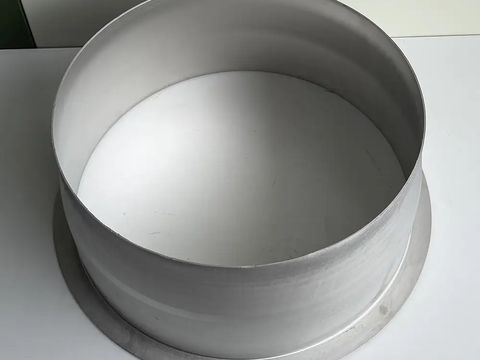
Handling Thick-Walled Cylinders
Spinning thick-walled metal cylinders is a highly demanding process that requires precise control of force, material behavior, and process stability to ensure reliable results.
Handling Thick-Walled Cylinders
Handling thick-walled metal cylinders presents significant technical challenges in metal spinning. The primary difficulty lies in managing the extremely high forming forces required to plastically deform robust materials while preserving their structural integrity.
Processing thick-walled cylinders demands heavy-duty spinning machines capable of delivering substantial axial and radial forces. One of the most common risks is material cracking or uncontrolled deformation under excessive pressure, which can lead to dimensional inaccuracies or structural defects. In addition, maintaining uniform wall thickness throughout the forming process is critical to avoid localized weak points that may fail under mechanical or pressure loads.
Examples of Materials and Their Specific Challenges
Steel (Grade 50):
Known for its high strength and toughness, Grade 50 steel requires very high forming forces, especially when wall thickness exceeds 1 inch. The main challenge is preventing cracking while maintaining consistent wall thickness and dimensional accuracy.
Aluminum:
Aluminum is generally easier to spin due to its lower density and good ductility. However, thick-walled aluminum cylinders are susceptible to wrinkling and buckling if forming forces and tool paths are not carefully controlled.
Titanium:
Valued for its exceptional strength-to-weight ratio, titanium presents unique challenges due to its tendency to work-harden rapidly. Without precise process control, spinning can result in surface defects, excessive tool wear, or high residual stresses within the part.
RFQ – Get a Quote
- Precision Custom Metal Spinning Parts
- 👉 Upload your drawings and receive a quotation within 24 hours.


