 English
 Deutsch
 Русский
 العربيّة

CNC Spun Aluminum Nose Fairing for Long-Endurance UAV
High-precision CNC metal spinning of 6063 aluminum UAV nose fairing. Seamless aerospace-grade aluminum fairings with optimized aerodynamics, lightweight design, and AS9100 certification.
1. Industry Background
The aerospace UAV (Unmanned Aerial Vehicle) industry demands exceptional performance in:
- Lightweight structural design
- Aerodynamic optimization
- Structural integrity
- Impact resistance
- Environmental durability
Our client, a leading UAV manufacturer, developed a long-endurance reconnaissance drone designed to operate under extreme conditions:
- High altitude: above 5,000 meters
- Strong wind conditions: ≥ 15 m/s
- Wide temperature range
The nose fairing, positioned at the UAV’s forward fuselage, is a critical aerodynamic and structural component. It must:
- Minimize aerodynamic drag
- Maintain structural rigidity
- Withstand impact loads
- Resist thermal cycling
The previous solution used a segmented welded fabrication process, which resulted in:
- Visible seams
- Higher drag coefficient (Cd = 0.32)
- Excess weight (1.1 kg)
- Structural detachment risk at high altitude
To meet performance requirements, the client required a seamless, one-piece CNC metal spinning solution.
2. Product Specifications
Custom CNC Spun 6063 Aluminum UAV Nose Fairing
- Maximum Diameter: Ø450 mm
- Height: 320 mm
- Aerodynamic streamlined geometry
Wall Thickness:
- Main body: 1.2 ± 0.1 mm
- Root flange (mounting section): 3.0 mm reinforced
Material:
- Aluminum Alloy 6063 (ASTM B209 compliant)
- Tensile strength: ≥ 215 MPa
- Yield strength: ≥ 170 MPa
- Excellent corrosion resistance and weldability
Surface Treatment:
- Clear anodizing
- Oxide thickness: 10–12 μm
- Surface hardness: ≥ 300 HV
3. Core Manufacturing Process
3.1 Material Inspection and Blank Preparation
- 6063 aluminum sheet certified to ASTM B209
- Ultrasonic testing (UT) to ensure no internal defects
- CNC laser cutting with ±0.05 mm tolerance
- Stress-relief annealing at 350°C for 1 hour
This process eliminates internal stress prior to spinning.
3.2 CNC Cold Metal Spinning
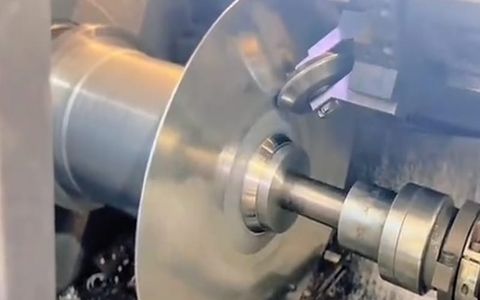
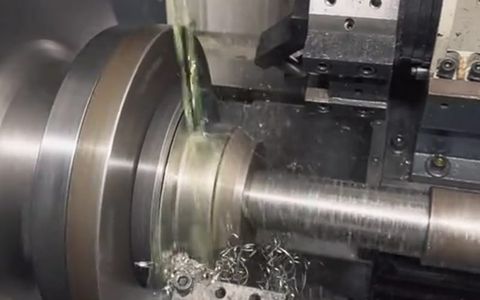
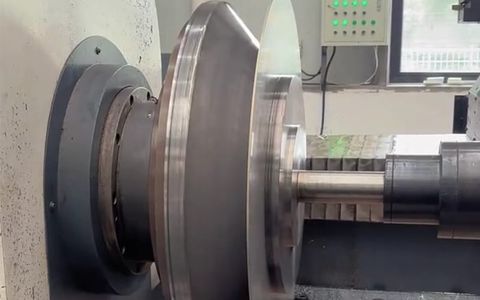
Manufactured using a horizontal 3-roller CNC spinning machine.
Process parameters:
- Feed rate: 5 mm/s
- Spinning force: 80 kN
- Multi-pass progressive cold spinning (4 passes)
Forming sequence:
- Pass 1: 25% reduction — primary contour shaping
- Pass 2–4: Progressive contour refinement
Result:
- Seamless, monolithic structure
- No weld lines
- No stress concentration zones
3.3 Precision Surface Refinement
- Custom fixturing system
- CNC surface grinding
- Surface roughness: Ra ≤ 0.8 μm
- Aerodynamic curvature tolerance: ≤ 0.1 mm
Ensures aerodynamic geometry accuracy.
3.4 Mounting Flange Machining
- CNC turning of root flange
- 6 × M8 threaded holes
- Thread tolerance class: 6H
Ensures secure fuselage integration.
3.5 Surface Treatment
Pre-treatment:
- Degreasing
- Acid pickling
- Alkaline cleaning
Followed by anodizing:
- Uniform oxide layer formation
- Hardness ≥ 300 HV
- Enhanced corrosion and wear resistance
3.6 Finished Product Inspection
- 3D laser scanning for full profile verification
- Wind tunnel testing for drag coefficient validation
- Drop impact testing (1 kg steel ball from 1 m height)
- Thermal cycling test: -40°C to 60°C
Results:
- No deformation
- No cracking
- No coating delamination
4. Our Core Advantages
4.1 Aerodynamic Precision Engineering
Through design optimization and iterative wind tunnel validation, we achieved:
Drag coefficient (Cd): 0.25
Improvement over previous solution: -21.9%
Exceeding client target (Cd ≤ 0.30).
4.2 Lightweight Structural Optimization
Weight reduction:
1.1 kg → 0.8 kg
Reduction: 25%
Cold spinning ensures:
- Optimized grain flow orientation
- Increased impact strength (+40%)
- Superior fatigue resistance
4.3 Seamless One-Piece Forming
Compared to welded construction:
- Eliminates joint failure risk
- Eliminates stress concentration
- Improves structural integrity
- Product yield rate: 99.8%
- Service life extended to 8 years
4.4 Rapid Customization Capability
- In-house engineering & programming team
- 3D CAD-to-spinning path conversion
- Prototype delivery within 7 days
- Flexible transition from low-volume to mass production
5. Product Validation and Performance Testing
Aerodynamic Performance
Wind tunnel verified:
Cd = 0.25
21.9% drag reduction
UAV endurance increased by 15%.
Structural Strength Testing
- 1 kg impact test: no visible damage
- Mounting tensile strength ≥ 3000 N
- 50-cycle thermal test (-40°C to 60°C): no structural degradation
Material & Surface Verification
- Spectrographic alloy confirmation (6063)
- 360-hour salt spray test: no corrosion
- Surface hardness ≥ 300 HV
Certification & Compliance
- AS9100 Aerospace Quality Management System
- Compliant with GB/T 38940-2020 Civil UAV Safety Standard
6. Customer Value Delivered
Aerodynamic & Endurance Improvement
- 21.9% drag reduction
- 15% endurance increase
Weight Reduction & Flight Safety
- 25% weight reduction
- Improved stability in strong wind (+30%)
- Eliminated joint detachment risk
Dimensional Accuracy & Assembly Efficiency
- Full-profile 3D laser validation
- Geometry deviation ≤ 0.1 mm
- Assembly efficiency improved by 50%
Scalable Production
- Monthly capacity: 3,000 units
- Prototype lead time: 7 days
- Supports rapid UAV model iteration