
 English
 Deutsch
 Русский
 العربيّة

Versatile Metal Spinning Technique
Versatile Metal Spinning Technique
ISO 9001:2015 Certified Quality Control System | Precision Metal Spinning & Flow Forming
Versatile Metal Spinning Technique
Metal spinning is a highly versatile manufacturing process capable of producing a wide variety of functional and decorative metal components. By combining rotational motion with localized pressure, this technique can form items ranging from industrial housings and lighting fixtures to aesthetic products such as bowls, vases, and decorative shells.
This article provides a comprehensive overview of metal spinning, covering its historical development, commonly used materials and tools, the core forming processes, and its broad industrial applications. Practical insights are also included to help ensure successful metal spinning projects.
Historical Background
Metal spinning is an ancient craft with origins tracing back to early civilizations in Egypt, China, and India, where it was used to produce ornamental vessels, tools, and weapons.
During the Middle Ages, advancements in rotational mechanisms significantly improved the process. Early bow-driven lathes were replaced by pedal-operated systems, freeing the craftsman’s hands and allowing better speed control. These lathes were more compact and precise, often resembling small workbenches.
The Industrial Revolution of the 18th and 19th centuries transformed metal spinning into a modern manufacturing process through the introduction of new materials, mechanized equipment, and improved tooling. Today, metal spinning is widely applied across industries such as aerospace, automotive, industrial equipment, and consumer products.
Materials Used in Metal Spinning
Common materials suitable for metal spinning include:
- Aluminum
- Brass
- Copper
- Stainless steel
- Mild steel
- Titanium
- Zinc
Material selection depends on the intended application, required mechanical properties, surface finish, cost considerations, and material availability.
Tools Used in Metal Spinning
Typical metal spinning tools and equipment include:
- Lathe: Rotates the metal workpiece at controlled speeds
- Mandrel: Supports and defines the internal shape of the part
- Chucks: Secure the workpiece to the lathe
- Rollers: Apply pressure to plastically deform the metal
- Cut-off tools: Trim and finish the final component
The Metal Spinning Process
Metal spinning consists of three primary forming methods: Conventional Spinning, Flow Forming, and Shear Spinning. These processes differ in material deformation behavior, roller positioning, mandrel usage, and forming temperature.
Conventional Spinning
Conventional spinning is the most widely used method. A flat metal disc is clamped onto a lathe and rotated at high speed while pressure is applied using a forming tool, traditionally referred to as a spoon. The metal is gradually displaced toward the center, forming the desired geometry through multiple passes. This method is suitable for producing shapes ranging from simple bowls to complex axisymmetric forms.
Flow Forming
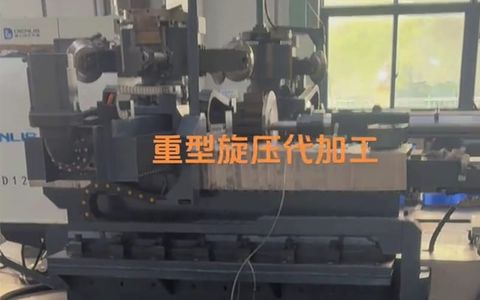
Flow forming, also known as tube spinning, is used to manufacture cylindrical or tubular components. A metal blank is rotated on a lathe while rollers apply pressure against a mandrel, causing the material to flow axially and radially. This process is commonly used for high-strength, thin-walled components such as rocket casings, pressure vessels, and automotive wheels.
Shear Spinning
Shear spinning involves controlled thinning and shaping of the metal blank. A disc is clamped to a lathe, and specialized tools apply force along a defined path to achieve conical or complex geometries. This method is ideal for producing cones, domes, and shapes that are difficult or impossible to form using conventional spinning.
Contact us and Request A Quote