
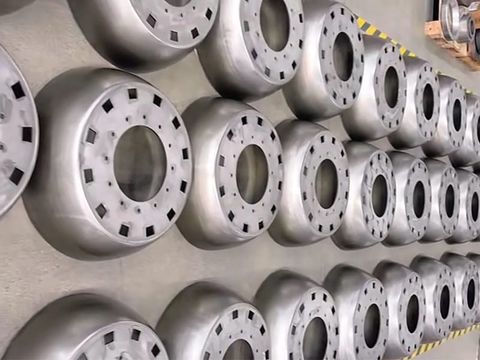
One-Stop Spun Parts
Each outside process adds a fixture, an inspection sheet and a datum. Six of them turn your ±0.3 mm into a sum of six.
Metal Spinning Process
The shell leaves for laser trimming on Monday and comes back Tuesday with a new fixture mark. Out again for welding, grinding, coating, plating, and every return brings an incoming inspection, a re-datum and another sheet of paperwork. A ±0.3 mm callout written on one drawing becomes the sum of six tolerances, none of them owned by the shop that did the metal spinning. When the plated batch misses concentricity, five suppliers write five explanations and your line waits for the sixth.
Under one roof the chain never breaks. The blank is laser cut, spin forming runs it over a single mandrel, robotic welding closes any joint the geometry needs, then grinding, polishing, coating and plating happen in the same building. Metal spinning displaces the wall rather than cutting it away, so the shell keeps its grain flow and its centerline; the weld is made before coating, so the seam is never re-clamped at a subcontractor. One drawing revision, one inspection report, one purchase order.
On 304 and 316L that metal spinning route holds ±0.3 mm on diameter and Ra 0.8 µm off the mandrel, at up to 2,400 mm diameter and 10 mm blank thickness. Material utilization sits near 90% because the blank is a disc, and the tooling is one mandrel, which is why a 50-piece run of metal spun shells is still worth quoting.
It is the wrong buy for a 200,000-piece thin-wall cup, and it is unnecessary if you already own a qualified coating line and only need metal forming done. What arrives is not a half-finished shell but a metal spun, coated, plated component on one purchase order, measured against the datum it was spun on.